If you’re shipping wood-packaged goods across international borders, ISPM-15 isn’t optional. It’s the difference between a shipment that clears customs and one that gets held, re-treated, or refused at the port.
The rules themselves are straightforward once you understand them. But a single missing stamp or an untreated pallet can stall an entire container, and the cost of a delay almost always outweighs the cost of doing it right the first time.
This guide breaks down what ISPM-15 is, what it applies to, how compliant wood is treated and marked, and how to make sure your next international shipment moves without a hold.
Quick Nav Menu
- What is ISPM-15?
- What ISPM-15 Applies To
- Approved Treatment Methods
- How to Read the Stamp
- Why Shipments Get Rejected
- Do You Need ISPM-15? Questions to Ask
- Shipping with a Certified Partner
What is ISPM-15?
ISPM-15 stands for International Standards for Phytosanitary Measures No. 15. It’s a global regulation developed by the International Plant Protection Convention (IPPC) that governs how wood packaging material is treated before it moves between countries.
The purpose is pest control. Raw, untreated wood can harbor insects, larvae, and fungi that become invasive species when introduced to a new environment. ISPM-15 requires that wood packaging be treated to eliminate those pests, then marked with an internationally recognized stamp certifying the treatment.
More than 180 countries recognize and enforce the standard, which means the same rules apply whether your shipment is headed to Germany, Brazil, or Japan. A crate treated and marked to ISPM-15 in the United States is accepted at ports worldwide.
SharkCrates Tip: ISPM-15 governs the wood packaging, not the product inside it. A perfectly packed shipment can still be held at customs if the crate or pallet underneath it isn’t compliant.
What ISPM-15 Applies To
ISPM-15 covers solid wood packaging made from raw wood, whether softwood (coniferous) or hardwood (non-coniferous). If it’s built from raw lumber and used to move goods across borders, it falls under the standard.
Covered materials include:
- Shipping crates and boxes
- Pallets
- Skids and bases
- Dunnage (the loose wood used to brace and secure a load)
- Crating, blocking, and bracing components
Not everything wood-based is regulated. Processed wood products are exempt because the heat, glue, and pressure used to manufacture them already eliminate pest risk.
Exempt materials include:
- Plywood
- Oriented strand board (OSB)
- Particleboard
- Wood 6mm thick or thinner
- Non-wood packaging like plastic and metal
There’s an important catch. The exemption only applies when a unit is made entirely of exempt material. If a crate or pallet combines processed panels with any raw wood components, such as solid runners or framing, the whole unit must be treated and marked.
One more distinction that trips up a lot of shippers: ISPM-15 applies to international shipments only. Wood packaging used for domestic freight within a single country doesn’t require treatment or a stamp, though some regions maintain separate quarantine rules for pest-affected zones.
SharkCrates Tip: A “wood pallet” isn’t automatically compliant just because it’s wood. What matters is whether it’s built from raw lumber, and whether it’s been treated and marked. When in doubt, look for the stamp.
Approved Treatment Methods
Before wood packaging can carry an ISPM-15 mark, it has to be treated by an approved method that eliminates pests throughout the entire wood profile, including the core, where insects and larvae hide. There are a few recognized methods, but two account for nearly all compliant packaging in practice.
Every method has one thing in common: the wood must be debarked before treatment. This prevents re-infestation while the lumber is stored or after the packaging is built.
Heat Treatment (HT)
The most common method by far. Wood is heated in a chamber, using either conventional steam or a dry kiln, until the core of the thickest component reaches a minimum of 56°C (133°F) and holds there for at least 30 continuous minutes. That core temperature is the whole point. Surface heat doesn’t count, because pests live deep in the wood.
This is the method SharkCrates uses. Every crate we produce is heat-treated to the 56°C / 30-minute standard and marked accordingly.
Dielectric Heating (DH)
A newer method that uses microwaves or radio-frequency energy to heat the wood from within. The threshold is stricter: the entire wood profile, including the surface, must reach at least 60°C for a minimum of one continuous minute. It’s well suited to smaller or irregularly shaped pieces.
Methyl Bromide (MB)
A chemical fumigation method that seals wood in a chamber and introduces gas to kill pests. Once widespread, it has been heavily restricted worldwide due to environmental and health concerns and is banned across the EU. It still appears on some shipments but is increasingly rare.
| Method | Code | Requirement |
|---|---|---|
| Heat Treatment | HT | Core temp of 56°C held for 30+ continuous minutes |
| Dielectric Heating | DH | Entire profile heated to 60°C for at least 1 minute |
| Methyl Bromide | MB | Chemical fumigation; heavily restricted, banned in the EU |
One common mix-up worth clearing up: kiln-dried lumber (marked KD) is not the same as heat-treated. Kiln-drying lowers moisture content, but most kilns run below the 56°C threshold and don’t verify core temperature. Only wood proven to hit the 56°C / 30-minute standard earns the HT mark. Some wood is both dried and treated, and gets stamped KD-HT.
SharkCrates Tip: A “wood pallet” isn’t automatically compliant just because it’s wood. What matters is whether it’s built from raw lumber, and whether it’s been treated and marked. When in doubt, look for the stamp.
How to Read the Stamp
Every piece of ISPM-15 compliant wood packaging carries a mark, often called the “wheat stamp” for the stylized grain symbol at its center. This mark is your proof of compliance. Customs officials look for it, and its absence is one of the most common reasons shipments get held.
The mark must be legible, permanent, and applied to at least two opposite sides of each crate or pallet so it’s visible no matter how the unit is positioned.
Here’s what each element means, using a real SharkCrates stamp as the example:
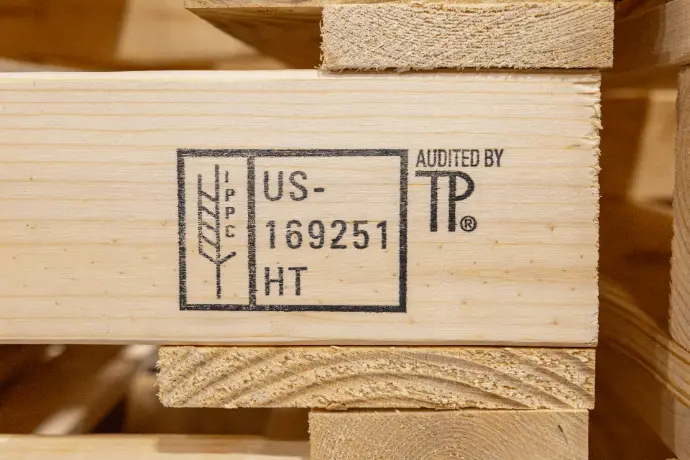
What’s in the stamp?
Hover or tap any numbered marker to learn what that part of the ISPM-15 stamp certifies.
SharkCrates Tip: The mark should never appear in red or orange. Those colors are reserved for other regulatory purposes. A legitimate ISPM-15 stamp is applied in a neutral, permanent ink, and should not be hand-drawn after the fact.
Why Shipments Get Rejected
ISPM-15 is enforced, not suggested. Customs authorities inspect wood packaging at ports of entry, and non-compliant shipments don’t get waved through with a warning.
When a shipment fails inspection, the consequences fall on the shipper and land fast:
- Holds and quarantine. The shipment is stopped at the port for secondary inspection while your cargo sits.
- Forced treatment or repackaging. You may be required to fumigate, remediate, or re-crate the shipment, at your expense.
- Re-export or destruction. In serious cases, the entire shipment is sent back to origin or destroyed, again on your dime.
- Demurrage fees. While the container sits in a holding area, the port charges daily storage fees that compound quickly.
- Fines and repeat-offender flags. Penalties can be steep and repeat violations can trigger import alerts against the shipper.
The common thread: every one of these is avoidable. Most rejections trace back to a handful of preventable causes.
The usual culprits:
- Missing stamp entirely
- Untreated or improperly treated wood
- Illegible or damaged marks
- Mixed-material units where raw wood components were never treated
- Marking format errors
That last one is extremely relevant today. As of 2026, inspectors are again enforcing the exact marking format, and small deviations get flagged. A mark reading “US 169251” with a space instead of “US-169251” with a hyphen can be enough to hold a shipment in strict ports like those in Australia and the EU, where on-site remediation often isn’t even offered.
SharkCrates Tip: The math almost never favors cutting corners. Compliant packaging costs a few dollars more per unit. One rejected shipment can cost you the demurrage, the re-treatment, the re-export, and the delivery delay all at once. Compliance is the cheap option.
Do You Need ISPM-15? Questions to Ask
Not every shipment requires ISPM-15 and figuring out whether yours does comes down to a few straightforward questions. Run through these before you ship.
Is the shipment crossing an international border?
This is the first and biggest filter. ISPM-15 applies only to international shipments. Wood packaging used for domestic freight within a single country doesn’t require treatment or a stamp. The moment your goods leave the country, the standard applies.
Is there raw wood in the packaging?
ISPM-15 governs solid, raw wood: crates, pallets, skids, blocking, bracing, and dunnage. If your packaging includes any of these, it needs to be compliant. If it’s built entirely from exempt materials like plywood, OSB, particleboard, plastic, or metal, you’re outside the standard.
Are you sure the whole unit is exempt?
This is where shippers get caught. A crate that mixes processed panels with raw wood runners or framing is not exempt. If any raw wood component is present, the entire unit must be treated and marked.
Does the wood already carry a valid stamp?
If you’re reusing packaging, don’t assume it’s still good. Check for a legible IPPC mark with a treatment code (HT or DH). Reused pallets and crates are a frequent source of rejections when the mark is missing, worn, or was never there to begin with.
Do you know your destination country’s specific rules?
ISPM-15 is the baseline, but some countries layer on stricter requirements, such as bark-free rules or additional documentation. When in doubt, verify the destination country’s requirements before the shipment leaves.
Shipping with a Certified Partner
The simplest way to stay compliant is to source your wood packaging from a certified facility. When your crates and pallets come from a partner who treats and marks to standard, compliance is handled before the packaging ever reaches your dock.
SharkCrates is an ISPM-15 certified facility, a member in good standing with Timber Products Inspection’s Heat Treatment program since 2018 and accredited through the American Lumber Standard Committee. Every crate we produce is heat-treated to the 56°C core standard, marked correctly, and backed by the chain-of-custody records the standard requires. When you ship in a SharkCrate, the wood packaging is already handled.
Ready to ship compliant? Shop Crates, browse our Pallet Collars, or request a Custom Quote for your next shipment.